
As Fiber-to-the-Home (FTTH) deployments continue to expand across the United States, engineering firms, broadband providers, and telecom contractors face increasing pressure to deliver projects on aggressive schedules while navigating complex municipal permitting requirements.
Whether a project involves directional boring, conduit installation, aerial fiber placement, handhole construction, or network maintenance, work occurring within the public right-of-way often requires permits from cities, counties, state departments of transportation, or other agencies.
One of the most commonly overlooked—but critically important—components of these permit applications is the Traffic Control Plan (TCP).
For telecom engineers, OSP designers, and construction project managers, TCPs can significantly impact permitting timelines, project schedules, and construction start dates. Understanding how Traffic Control Plans fit into the fiber optic permitting process can help teams avoid delays and keep broadband deployment projects moving forward.
What Is a Traffic Control Plan?
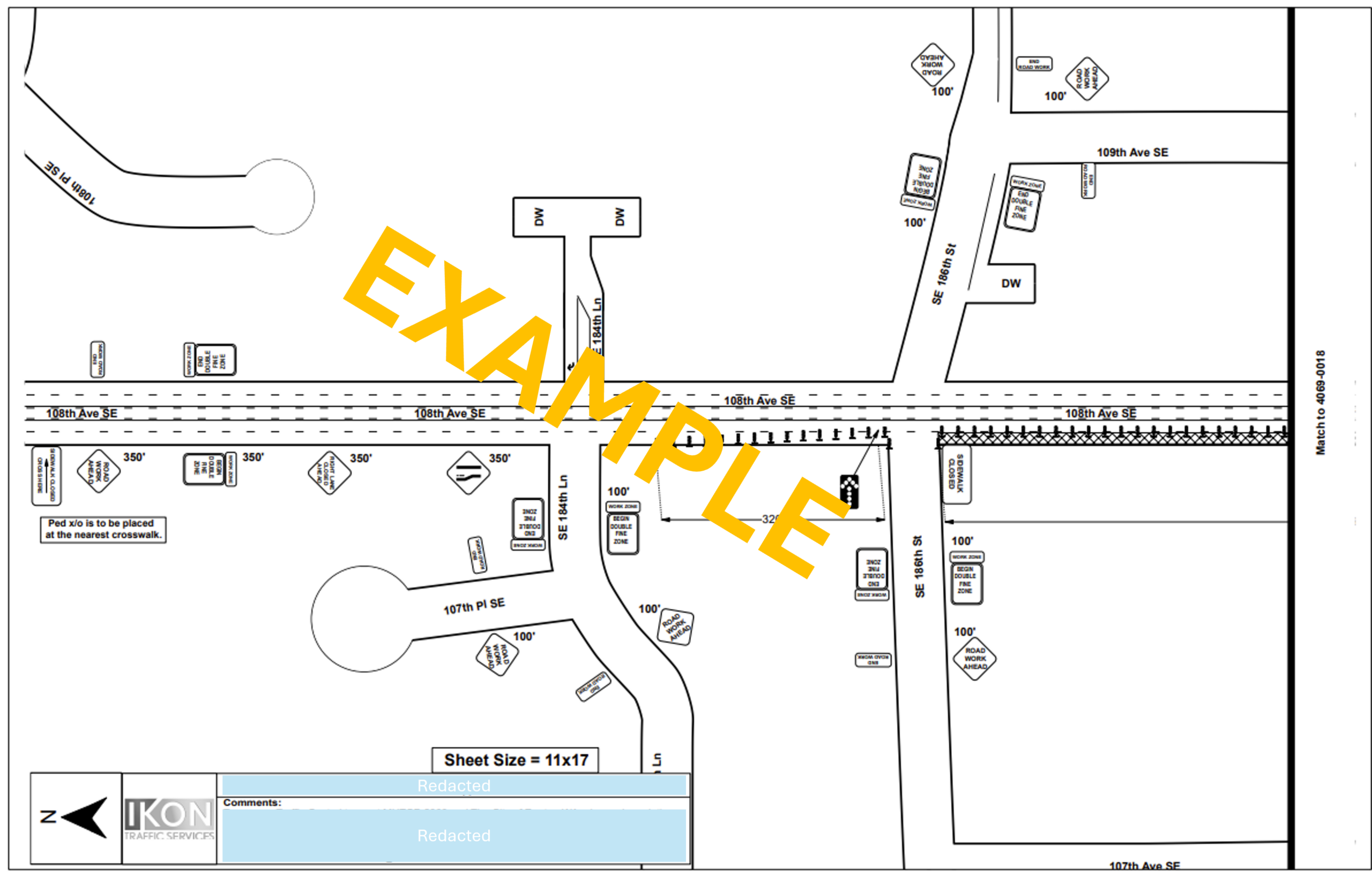
A Traffic Control Plan is a detailed document that illustrates how traffic, pedestrians, cyclists, and construction activities will be safely managed while work occurs within or adjacent to a roadway, sidewalk, shoulder, bike lane, or intersection.
Most TCPs include:
- Temporary traffic control devices
- Work zone layouts
- Sign placement
- Cone and channelization device placement
- Flagging operations
- Pedestrian accommodations
- ADA-compliant sidewalk detours
- Lane closure details
- Work area dimensions
- MUTCD-compliant traffic control standards
Municipal agencies review these plans to verify that construction activities can be completed safely while minimizing disruption to the traveling public.
For fiber optic construction projects, TCP requirements commonly apply to:
- Directional boring operations
- Open trench construction
- Utility potholing
- Fiber splicing activities
- Handhole installation
- Vault installation
- Pole replacement work
- Aerial fiber construction
- Sidewalk closures
- Shoulder closures
- Single-lane closures
- Multi-lane closures
- Intersection work
Even projects that only occupy a shoulder or sidewalk may require a Traffic Control Plan before permits are issued.
Why Municipalities Require Traffic Control Plans for FTTH Construction
As communities continue expanding broadband infrastructure, municipalities face the challenge of balancing construction activity with public safety.
When reviewing fiber construction permits, agencies evaluate:
- Traffic impacts
- Pedestrian safety
- ADA accessibility
- Emergency vehicle access
- School zone impacts
- Construction worker safety
- Access to homes and businesses
A properly designed Traffic Control Plan demonstrates that these concerns have been addressed before construction begins.
Many jurisdictions specifically require TCPs that comply with the latest Manual on Uniform Traffic Control Devices (MUTCD) standards, along with local agency requirements and engineering guidelines. In many cases, permit applications cannot be approved until a compliant Traffic Control Plan has been reviewed and accepted.
Traffic Control Plans and Fiber Right-of-Way Permits
For most FTTH deployments, obtaining a Right-of-Way (ROW) permit is a critical step before construction can begin.
Whether a project involves directional drilling, conduit installation, handhole placement, aerial fiber deployment, or maintenance activities, municipalities typically require contractors to demonstrate how traffic and pedestrian movements will be safely managed throughout construction.
As a result, Traffic Control Plans have become a standard requirement for many fiber optic permitting processes.
Many agencies require TCPs as part of:
- Right-of-Way permits
- Utility construction permits
- Street occupancy permits
- Excavation permits
- Lane closure permits
- Sidewalk closure permits
- State DOT permits
Permit reviewers use these plans to evaluate how proposed fiber construction activities will impact public travel and whether traffic control measures comply with local standards and MUTCD requirements.
For broadband providers and telecom engineering firms, a well-developed TCP can help reduce permit review cycles, minimize agency comments, and accelerate project approvals.
As municipalities continue increasing oversight of utility construction within public rights-of-way, Traffic Control Plans are becoming an increasingly important component of successful FTTH permitting.
Why Telecom Experience Matters When Developing Traffic Control Plans
Not all Traffic Control Plan providers understand the realities of fiber network construction.
Many traffic control firms primarily support roadway construction projects and may have limited familiarity with outside plant (OSP) engineering, directional boring operations, aerial fiber construction, splice locations, utility coordination, and broadband deployment workflows.
IKON brings a unique advantage through its relationship with Trace and Communication Construction & Engineering (CCE), companies that specialize in telecommunications engineering and broadband infrastructure construction.
This telecom-specific expertise allows our team to better understand:
- FTTH network architecture
- OSP engineering plans
- Fiber optic construction sequencing
- Utility coordination requirements
- Directional boring operations
- Fiber splice locations
- Handhole and vault placement
- Aerial fiber deployment
- Broadband expansion projects
Rather than simply producing a TCP, IKON develops permit-ready Traffic Control Plans that align with the realities of fiber network construction and municipal permitting requirements.
For engineering firms managing fiber optic permitting, broadband deployment projects, and utility infrastructure construction, this specialized knowledge can help reduce revisions and streamline the approval process.
Reducing Permit Delays Through Early TCP Coordination
One of the most common causes of permitting delays occurs when Traffic Control Plan development begins after engineering design is substantially complete.
When TCP development is treated as a last-minute requirement, teams frequently encounter:
- Permit resubmittals
- Missing traffic control details
- Conflicts between construction plans and TCP layouts
- Additional agency review cycles
- Delayed construction starts
Integrating Traffic Control Plan development early in the permitting process helps identify potential issues before permit packages are submitted.
By coordinating with engineering and design teams during project planning, permit-ready TCPs can be developed that align with both municipal requirements and construction operations.
This proactive approach often results in faster permit approvals and fewer review comments.
Why Traffic Control Plans Are Often Returned During Permit Review
Municipal reviewers evaluate hundreds of utility permits each year. Even relatively minor deficiencies can result in permit comments, resubmittals, and project delays.
Common reasons fiber construction TCPs are rejected include:
- Missing pedestrian detours
- Incomplete ADA accommodations
- Improper sign spacing
- Incorrect MUTCD applications
- Missing lane closure details
- Work areas extending beyond proposed construction limits
- Incomplete flagging operations
- Conflicts between engineering plans and traffic control layouts
- Missing notes required by local agencies
Working with a TCP provider that understands both traffic control requirements and fiber construction workflows can help reduce these common review comments and keep permitting schedules on track.
Nationwide TCP Support for Multi-Market Fiber Programs
Many broadband providers, engineering firms, and telecom contractors operate across multiple states and municipalities. Managing traffic control requirements across dozens—or even hundreds—of jurisdictions can create significant administrative challenges.
IKON supports clients nationwide by providing Traffic Control Plans for projects ranging from individual permit applications to large-scale regional broadband deployment programs.
Our team assists organizations working in:
- Urban markets
- Suburban communities
- Rural broadband projects
- State highway corridors
- Municipal road networks
- County road systems
Whether a project involves a single municipal permit or a multi-state fiber expansion initiative, IKON provides scalable TCP support designed to help engineering teams maintain project momentum and keep construction schedules on track.
Frequently Asked Questions About Traffic Control Plans for FTTH Projects
Do fiber optic construction projects require a Traffic Control Plan?
In most municipalities, a Traffic Control Plan is required whenever fiber construction impacts a roadway, shoulder, sidewalk, bike lane, intersection, or other portion of the public right-of-way.
What is the purpose of a Traffic Control Plan for FTTH construction?
A TCP demonstrates how traffic, pedestrians, cyclists, and construction crews will be protected while fiber optic construction activities occur within the public right-of-way.
Are Traffic Control Plans required for directional boring projects?
Many jurisdictions require TCPs for directional drilling and boring operations because construction crews, support vehicles, equipment, and material staging areas often occupy portions of the roadway or shoulder.
Who prepares Traffic Control Plans for fiber permitting?
Traffic Control Plans are typically developed by specialized traffic control professionals familiar with MUTCD standards, local permitting requirements, utility construction practices, and right-of-way regulations.
Can the same TCP be used in multiple municipalities?
Generally, no. Each municipality may have unique traffic control standards, permit requirements, work hour restrictions, and review procedures that require project-specific TCPs.
How long does it take to prepare a Traffic Control Plan?
Project complexity, permit requirements, and agency standards all affect development timelines. Simple shoulder closures may be completed quickly, while complex urban roadway closures may require more detailed planning.
Does IKON provide Traffic Control Plans outside Colorado?
Yes. IKON develops Traffic Control Plans for fiber optic construction, broadband deployment, utility infrastructure projects, and telecommunications construction throughout the United States.
Can IKON support large multi-state FTTH deployment programs?
Absolutely. IKON works with engineering firms, broadband providers, telecom contractors, and utility construction teams that require scalable TCP support across multiple jurisdictions and markets.
Partner With IKON for Your Next FTTH Deployment
Traffic Control Plans are far more than a permitting requirement—they are a critical component of successful fiber network construction.
By partnering with a team that understands both traffic control and telecommunications infrastructure, engineering organizations can streamline permitting, reduce revisions, and keep projects moving toward construction.
IKON works directly with telecom engineers, OSP designers, broadband providers, utility contractors, and construction managers to develop permit-ready Traffic Control Plans nationwide.
Whether you’re submitting a single Right-of-Way permit or managing a multi-state fiber expansion program, our team can help simplify the permitting process and keep your deployment schedule on track.
Ready to discuss your next project?
Contact IKON today: https://ikontraffic.com/contact/